
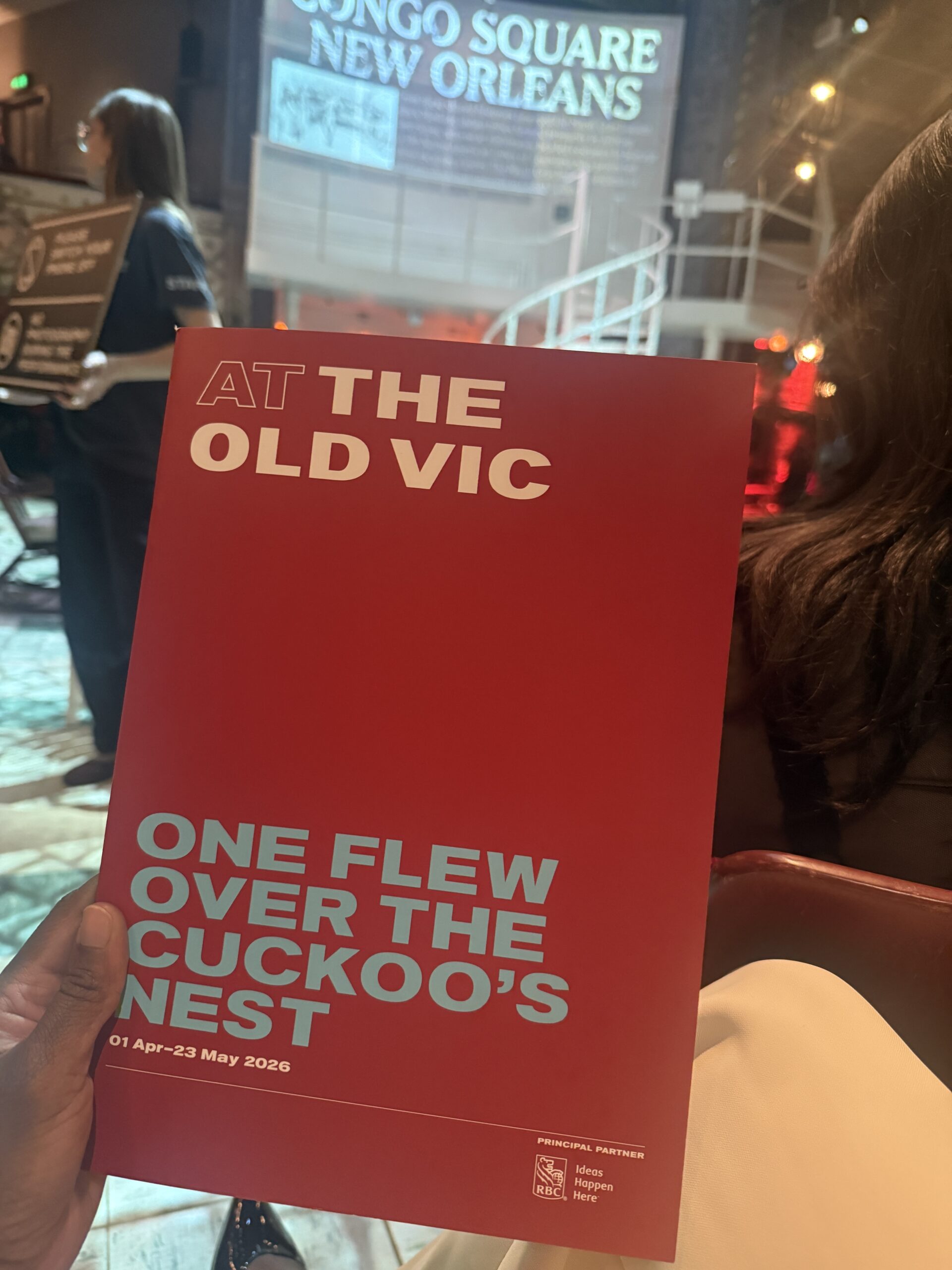
What Clint Dyer’s One Flew Over the Cuckoo’s Nest Taught Me About Institutional Power
There is a kind of irony in taking the red-eye from JFK to London Heathrow to watch an American classic activated by a British cast. Yet, sitting in the historic Old Vic for the final weekend of One Flew Over the Cuckoo’s Nest, the distance felt necessary.
Director Clint Dyer did not alter Dale Wasserman’s stage adaptation of Ken Kesey’s novel. Instead, he retained the original text and populated the psychiatric ward with a majority Black cast representing the African diaspora, while preserving the Indigenous heritage of Chief Bromden (Arthur Boan).
The tension in the room was immediate and unmistakable: to expose the modern machinery of not only racial control, but institutional as well, Dyer didn’t need to rewrite the narrative. He only needed to change the bodies subjected to it.
The Architecture of Institutional Power
While some have debated the friction between Kesey’s 1960s source material and this 2026 lens, the production succeeds at doing exactly what meaningful and moving cultural work must do: it expands the mind and forces the audience to study the anatomy of power.
The sterile, in-the-round set becomes an enclosure, mirroring corporate and institutional spaces where surveillance is constant and compliance is the only acceptable currency. Systems of control, we are reminded, are rarely about the stated rules; they are rooted entirely in the preservation of authority. Whether in a psychiatric ward or an executive boardroom, the structure thrives on the reduction of the full human and the systematic punishment of anyone who refuses that reduction.
The Activator and The Witness: Archetypes of Survival
This diaspora-focused lens of One Flew Over the Cuckoo’s Nest is anchored by an electric Aaron Pierre as Randle McMurphy, the meticulously composed Giles Terera as Dale Harding, an ever observant Arthur Boan as Chief Bromden, and the innocent approval-seeking Kedar Williams-Stirling as Billy Bibbit. From this ensemble, two distinct archetypes of institutional survival emerge. I call them The Witness and The Activator.
The Witness is the role we adopt for self-preservation — the calculated, quiet compliance of someone who sees the system clearly and determines the cost of challenging it is too high. The Activator, embodied by Aaron Pierre’s disruptive force, is the posture we take when we decide the risk of retaliation is worth the awakening.
The interplay between these two forces is the core dynamic of any high-stakes environment. The ensemble expertly navigated this tension, using historical context and moments of levity to map the Black experience onto heavy themes of conformity and systemic oppression.
The Final Mandate for High Performers
Dyer’s vision of One Flew Over the Cuckoo’s Nest demands that we look beyond the surface of the text and evaluate our own spaces. It asks high-performing professionals a quiet but critical question: Are you the Activator, absorbing the friction to create space for others? Or are you the Witness, waiting for permission to claim your agency?
Institutions are designed to convince us the ward is all there is. But the poem McMurphy and Bromden speak together doesn’t end with a locked door. It ends with a goose — and an out. Dyer’s production leaves you with one question: not whether the exit exists, but whether you’ve already decided to take it.
