Securing the Record: What The Eyes of Ghana Teaches Us About Institutional Amnesia
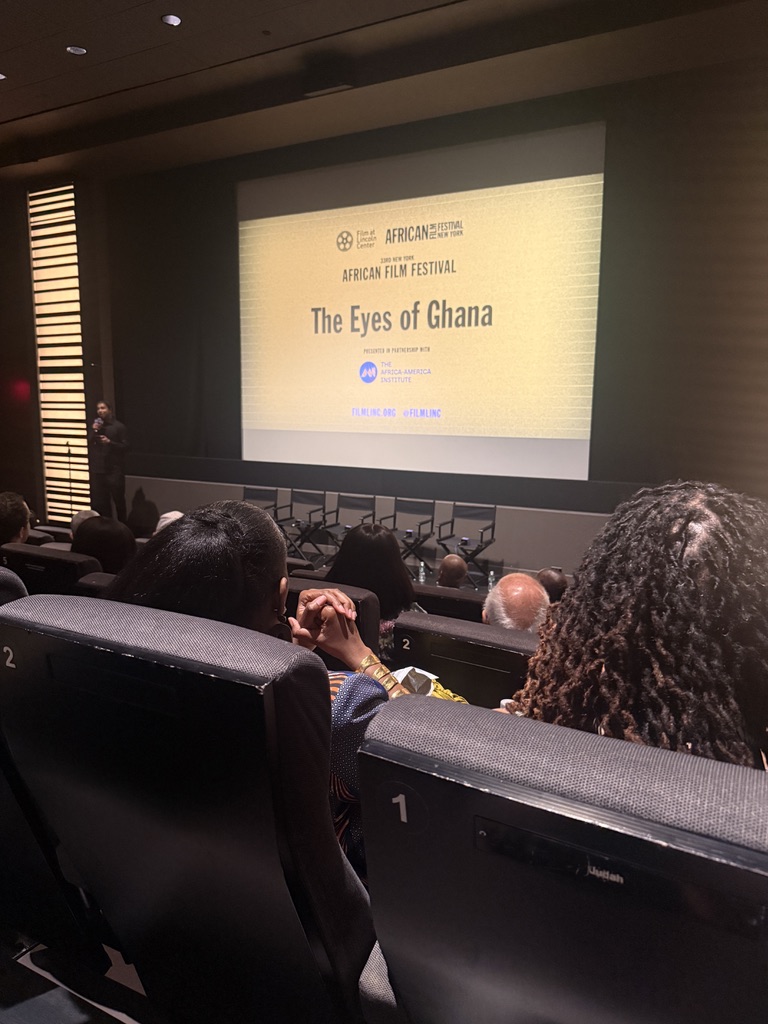
There was a distinct wonder that would light up my mother’s eyes when she spoke of her early teen years in Ghana. She would recall the Roxy, the Rex, and the Palladium — cinemas where she and her friends would sneak in to watch films like Sabrina (1954), glimpsing a world beyond their borders and recognizing the global presence Ghana was on its way to building. That trajectory took a violent turn during the military coup d’état of 1966, but her belief in cinema’s ability to reveal alternative realities was already firmly in place. It is a gift she passed down to me. At the 2026 New York African Film Festival, the documentary The Eyes of Ghana offered me the profound opportunity to look back at that exact era through her eyes. It was, in the truest sense, a homecoming.
Chris Hesse and the Threat of Institutional Amnesia
Executive produced by Barack and Michelle Obama’s Higher Ground Productions, The Eyes of Ghana follows 93-year-old Chris Hesse, the personal cinematographer for Dr. Kwame Nkrumah. As the first president of Ghana, Nkrumah led the first Sub-Saharan African nation to independence from colonial rule. Following the 1966 coup, the new regime operated on a playbook of institutional amnesia, working under the presumption that they had successfully destroyed every reel of film documenting Nkrumah’s era. They hadn’t. Over 1,000 reels were quietly saved, and the documentary joins Hesse and a new generation racing to restore the visual history of a nation.
Watching Nkrumah’s historic speeches, the fireworks, and the sheer joy of a newly liberated nation digitally remastered — I stopped being an audience member. In those moments, the theater transformed into the Old Polo Grounds. But the true masterclass of The Eyes of Ghana is not just in the footage; it is in Hesse’s philosophy of the record.
The Architecture of Truth: Why Authority Never Argues
At one point, a student asks Hesse to provide proof of Nkrumah’s greatness — reflecting the reality of younger generations who were taught to view him strictly as a dictator and oppressor. Hesse’s answer is the film’s quiet masterclass: it is not the job of a documentarian to prove anything. It is their job to capture the moment, the feeling, the unfiltered reality. The conclusion belongs to the viewer.
This is what Institutional Amnesia cannot survive — a protected archive. The coup presumed the reels were gone. They weren’t. Over 1,000 of them waited in silence, carrying everything the new regime needed the world to forget. Hesse understood something that every high performer navigating an institution that rewrites its own history needs to understand: true authority never argues its legacy. It simply protects the record. The archive is the argument.